How to Specify an Industrial Thermal Camera: A Buyer's Checklist
A practical buyer's guide to the specifications that decide an industrial thermal camera purchase — resolution, sensitivity, temperature range and optics — plus the RFQ fields and documents that turn a vague enquiry into a comparable quotation.
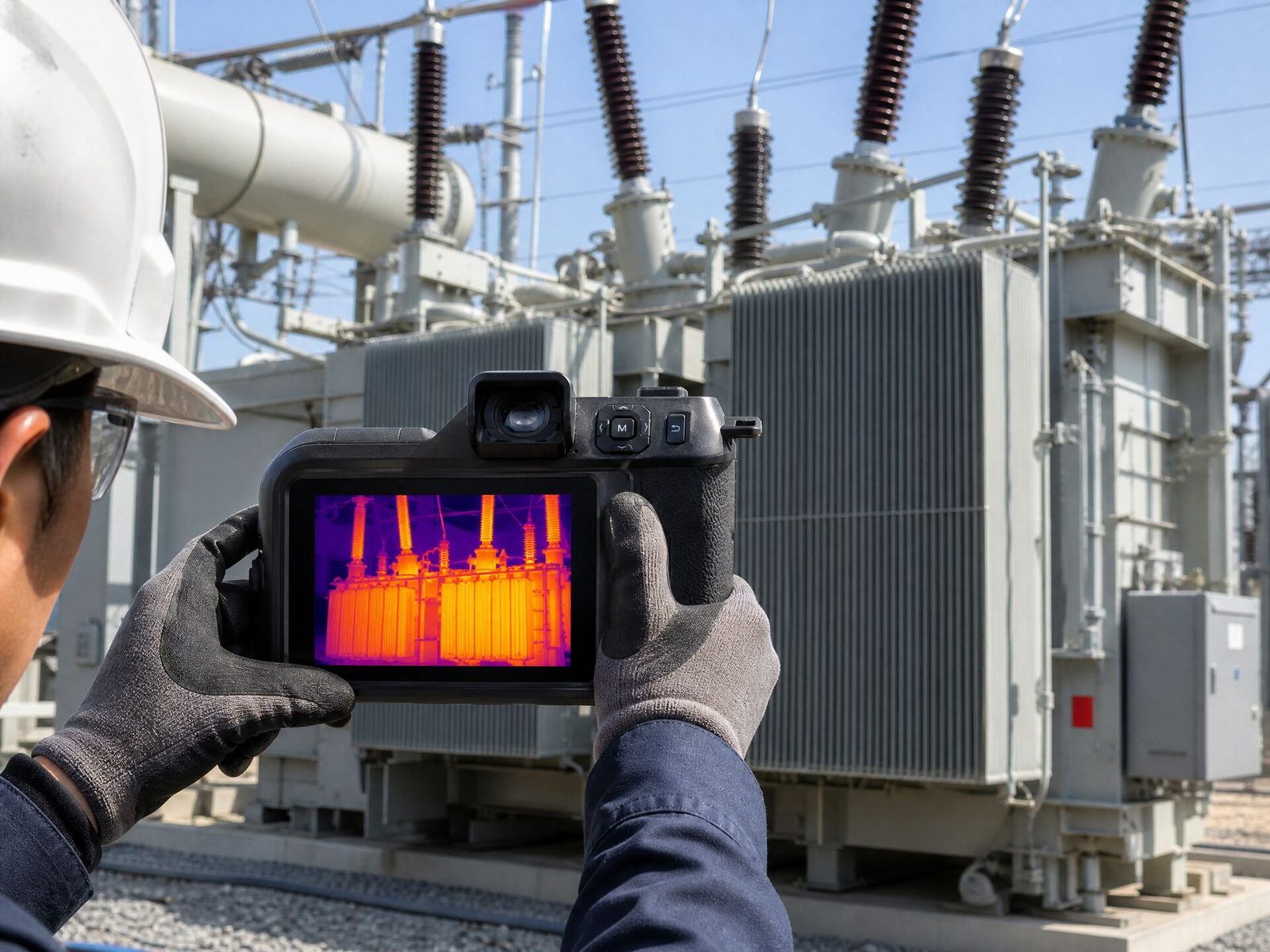
Buying an industrial thermal camera goes wrong in a predictable way. The buyer starts from a model name or a budget figure, buys either too little camera to resolve the target or too much camera for the job, and discovers the mismatch on the first survey. The fix is to specify the camera from the target outward: what you must see, from how far, through what temperature range, and with what evidence. This buyer's guide walks through that order, the specifications that actually decide the price, and the fields and documents that turn a vague enquiry into a quotation you can compare.
Everything below refers to models we supply and support: the EasIR Series, the Hammer II Series and the PT II Series. Where a specification is model-specific we say so, because a printed range for one variant must never be read as covering a whole series.
- The Short Answer
- What "Industrial" Changes in a Thermal Camera
- The Specifications That Decide the Purchase
- What Drives the Price of an Industrial Thermal Camera
- Handheld, Fixed, or Something Else?
- Documents to Request With a Quotation
- The Buyer's RFQ Checklist
- Common Specification Mistakes
- Frequently Asked Questions
- The Bottom Line
The Short Answer
An industrial thermal camera is specified by four decisions, in order: the infrared resolution you need to resolve your smallest target at your working distance, the thermal sensitivity (NETD) you need to reveal the temperature difference that matters, the temperature range your applications reach, and the optics and focus that put enough pixels on that target. Price follows those four choices far more than it follows the brand. Get them right and a correctly sized mid-range camera will outperform an oversized one for the same budget.
What "Industrial" Changes in a Thermal Camera
"Industrial" is not a marketing word; it describes a set of capabilities a consumer thermal device does not have. The most important is radiometry: every pixel reports a temperature, with spot, area and line measurement tools, rather than a colour-coded picture. That is what turns an image into an inspection record you can put in a report and defend.
The second is sensitivity. An industrial camera is built around a low NETD so that a small differential — a warm joint, a partial-discharge-heated termination, a bearing running a few degrees hot — stands out against a large ambient background. The third is consistency: manual or electric focus, a defined spectral range, a stated accuracy, and a calibration that can be traced and renewed. A tool that cannot be focused precisely or calibrated cannot be used for a repeatable programme.
Choose an industrial model when you need to…
- Measure temperature, not just see heat — report spot, area and line values with accuracy.
- Resolve small targets (terminations, clamps, small components) at a defined distance.
- Detect small temperature differences against ambient (NETD in the low tens of millikelvin or better).
- Work in a defined spectral and temperature range with a traceable calibration.
- Survive field work — drop protection, IP-rated housing, all-day battery.
A general-purpose or entry camera is usually enough when…
- You only need a qualitative picture of obvious hot spots at close range.
- You do not need per-pixel temperature values or formal reporting.
- You are inspecting surfaces, not small components viewed from a distance.
If your work is electrical inspection, switchgear, transformers or mechanical maintenance, you are in the first group, and the specification below applies.
The Specifications That Decide the Purchase
These are the four figures that decide how a camera performs in the field, and, in most projects, the price. The table maps them onto the three handheld lines we supply so the trade-offs are visible.
| Specification | EasIR Series | Hammer II Series | PT II Series |
|---|---|---|---|
| IR resolution | 256×192 or 384×288 @ 12 µm (model-dependent) | 384×288 (Hammer II) / 640×512 (Hammer II Pro) | 480×360 / 640×512 / 1024×768 / 1280×1024 (model-dependent) |
| Thermal sensitivity (NETD) | ≤15 mK @ 25 °C | ≤40 mK @ 30 °C | <20 mK @ 30 °C |
| Temperature range | −20 °C to +650 °C | −20 °C to +650 °C; up to +2000 °C optional | −20 °C to +650 °C; up to +2500 °C optional |
| Accuracy | As per model datasheet | As per model datasheet | ±2 °C or 2% of reading |
| Focus | Manual / auto | Manual / auto / electric, laser ranging to 40 m | 1-lens TwinView DFOV |
| Frame rate | 30 Hz / 9 Hz | 30 Hz | 50 Hz |
| Ruggedness / battery | IP54, 2 m drop, >12 h battery, ~0.6 kg | IP54, >3 h battery, 1.48 kg | IP54, 90% charge in 1 h |
Read the table in order. Resolution and distance come first: a target should cover at least three pixels for a trustworthy reading, so the smaller the target and the longer the distance, the higher the resolution you need. The EasIR Series at 256×192 or 384×288 suits close panel and cabinet work; the Hammer II Series at 384×288 or 640×512 is the working range for substation and industrial inspection; the PT II Series, up to 1280×1024 with a 50 Hz frame rate, is for small components at long range and for detailed documentation.
Sensitivity comes second and is the most under-specified figure in casual buying. NETD decides how faint a fault you can see, so a 15 mK camera reveals temperature differences a 40 mK camera renders as noise. NETD is quoted at a reference temperature, so compare like with like. Temperature range is third: standard handhelds cover roughly −20 to +650 °C, and the +2000 or +2500 °C span is an optional configuration for furnace and refractory work, not a default. Finally, optics and focus decide whether you can hold focus on the target from your actual working position; electric focus with laser ranging saves time on tall structures.
What Drives the Price of an Industrial Thermal Camera
An industrial thermal camera is priced by its detector, its optics and its verification — not by a single "good / better / best" tier. The table shows the drivers a buyer can actually control.
| Cost driver | Why it moves the price | How to avoid over-paying |
|---|---|---|
| IR detector resolution | The detector is the single most expensive component; pixel count rises steeply in cost | Size resolution to the smallest target and distance, not to the biggest number available |
| Thermal sensitivity (NETD) | Lower NETD needs a better detector and calibration | Only buy sensitivity your fault types demand |
| Temperature range | High-temperature spans need different detector/FPA options | Add the high-range option only if your applications reach it |
| Lens / field of view | Additional or telephoto optics are quoted separately | Pick one lens that matches your working distance; add a second only with a reason |
| Focus and ranging | Electric focus and laser ranging add mechanics and electronics | Worth it for tall or distant targets, not for bench-level work |
| Visible / dual channel | A second imaging channel adds a sensor and blending | Useful for documentation; not needed for pure measurement |
| Software and reporting | PC analysis and report tools are licensed separately | Confirm what is included before comparing two quotes |
| Calibration and documents | Traceable calibration and certificates add cost and lead time | Ask what is standard versus extra, per model |
| Quantity, packaging, Incoterms | Order size, neutral packaging and delivery terms all change the landed number | Put quantity, packaging and delivery country in the RFQ so the quote is comparable |
Two thermal camera quotations are only comparable when the resolution, NETD, temperature range, optics, software and documents are all fixed. A cheaper quote is usually a smaller specification, not a better deal.
This is why we do not publish a single "from" price for the range. The correct number depends on the configuration you actually need, and the fastest way to get it is to describe the job. If you are early in the process, the product selector narrows the model class from a few questions before you ask for pricing.
Handheld, Fixed, or Something Else?
A handheld industrial thermal camera is the right default for survey and diagnosis work, but it is one instrument in a programme. Before you buy, decide which job you are actually equipping.
| Job | Best instrument | Why |
|---|---|---|
| Full-site survey, diagnosis, reporting | Handheld industrial thermal camera | Operator-present measurement and images you can document |
| Watching a few critical assets every day | Fixed online thermal camera | Continuous coverage of assets that are hard to walk down |
| Confirming a hot spot is also discharging | HPD200 / HPD500 partial-discharge detector | Heat alone does not prove a discharge fault |
| SF6 leaks, compressed-air leaks, corona | Acoustic / gas imaging solution | These faults are found by sound or by gas visualisation, not by heat |
Thermography shows the heat a fault produces; it does not show the discharge or the gas. A substation programme usually pairs a handheld thermal camera with a partial-discharge detector and, for SF6 and compressed air, an acoustic or optical gas imaging solution. If your enquiry is about gas or leaks, say so — recommending a thermal camera for a job it cannot do helps nobody.
Documents to Request With a Quotation
For industrial buyers, the documents are part of the product. Ask for them by name, and confirm they apply to the exact model you are buying rather than to a series in general.
- Datasheet with the full model suffix — so resolution, NETD and temperature range are tied to one variant.
- Calibration certificate — what is calibrated, at which reference, and how it is renewed.
- IP-rating or safety certificates — applicable to the named model, not extended across a range.
- Test report scope — what was tested and what the report does and does not cover.
- Software and reporting documentation — what is included and what is licensed separately.
- Packaging and labelling specification — including any neutral or brand-specific requirement.
Certificate types, standard numbers and report dates are confirmed per model and per quotation. We state exactly which documents accompany a given model and which must be requested as an extra; we do not claim that one certificate covers a whole series.
The Buyer's RFQ Checklist
A complete enquiry is answered faster and quoted comparably. Copy these fields into your request to info@directofactory.com or send them on WhatsApp.
- Application — what you inspect (panels, switchgear, transformers, motors, solar, furnace…).
- Smallest target and working distance — the two figures that set the resolution and optics.
- Temperature difference you must see — which sets the NETD you need.
- Maximum temperature — standard or a high-temperature span.
- Handheld or fixed — survey tool or permanent monitoring.
- Quantity and delivery country.
- Documents required — calibration, certificates, test reports.
- Packaging / branding — neutral or branded.
- Any accessory — extra lens, tripod, hard case, spare battery.
With those fields filled in, the model class and optic can be confirmed in one reply instead of several rounds of questions.
Common Specification Mistakes
- Buying resolution for the brochure. Extra pixels only help if the target is small or the distance is long; for close panel work they add cost without adding information.
- Ignoring NETD. A high-resolution camera with poor sensitivity can miss faint faults a lower-resolution, sensitive camera would show.
- Assuming the high-temperature range is standard. The +2000 / +2500 °C span is an optional configuration on specific models.
- Comparing quotes at different specifications. Fix resolution, NETD, range, optics, software and documents before comparing numbers.
- Treating one certificate as covering the series. Certificates and IP ratings apply to the named model.
- Forgetting the job the camera cannot do. Thermal imaging does not replace discharge or leak detection.
Frequently Asked Questions
What resolution do I need in an industrial thermal camera?
Work from the target. Decide the smallest feature you must see and the distance you will stand at, then check the instantaneous field of view so that feature covers at least three pixels. A 256×192 camera suits close panel work; small targets at several metres need 384×288 or 640×512; fine detail at long range calls for the higher end of the PT II range.
Is NETD important in a thermal camera?
Yes — it is the smallest temperature difference the camera can resolve, and it decides how early a fault appears. A 15 mK camera shows faint differences a 40 mK camera renders as noise. Compare NETD values measured at the same reference temperature.
Do I need a high-temperature range?
Only if your applications reach it. Standard handhelds cover roughly −20 to +650 °C; furnace and refractory work can need up to +2000 or +2500 °C, which is optional on the Hammer II and PT II lines. Confirm the exact range and accuracy for your model in the quotation.
What documents should come with a thermal camera quotation?
Ask for the datasheet with the full model suffix, the calibration certificate, the IP or safety certificates that apply to the exact model, and the scope of any test report. Availability and certificate numbers are confirmed per model and quotation.
Can an industrial thermal camera be supplied in neutral packaging?
Neutral or unbranded packaging can be discussed, but availability depends on model, quantity and order requirements. Put it in the enquiry so it is confirmed in the quotation.
The Bottom Line
Specify the industrial thermal camera from the target outward: the resolution to see it, the NETD to reveal it, the range to measure it, and the optics to hold it in focus. Then fix the documents and packaging you need, and ask for a quotation with those fields stated. That single order of steps removes most of the risk in buying a thermal camera — and it is the same order we use when we size a model for a customer.
Not sure which model fits your job?
Send the application, the smallest target, the working distance, the temperature range, the quantity and the delivery country. We will confirm which model class and optic meets the specification, and whether we are the right supplier for the job.