SF6 Leak Detection: Optical Gas Imaging vs Acoustic Imaging
Two proven methods find leaks in switchgear, but they measure different things. This guide compares optical gas imaging and acoustic imaging on sensitivity, distance, cost and speed, so you can choose the right method for a survey or a compliance programme.
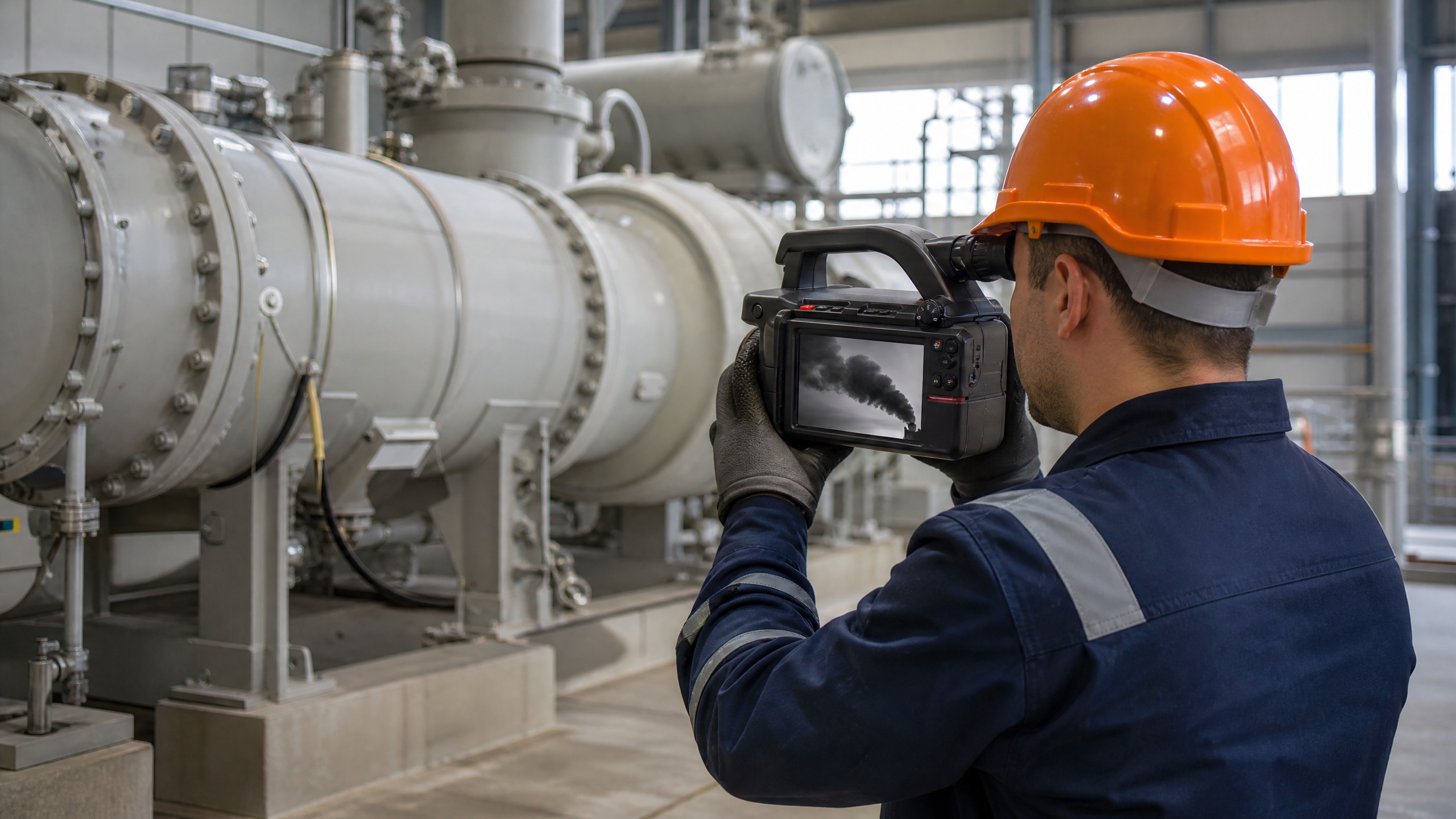
SF6 leak detection is a routine obligation for any utility that owns gas-insulated switchgear. The gas is an outstanding insulator and a potent greenhouse gas, so a slow leak is both an operating cost and a regulatory liability. Two technologies dominate field surveys: optical gas imaging (OGI) cameras that see the gas cloud itself, and acoustic imaging cameras that hear the ultrasonic signature of gas escaping under pressure. They are often presented as rivals. In practice they answer different questions, and the teams that get this right usually end up using both.
This guide is written for buyers and inspection managers: what each method actually measures, where one clearly beats the other, what the cameras cost in relative terms, and how to specify a system that survives a real switchgear survey rather than a demonstration.
- The Short Answer
- How Each Method Finds a Leak
- Head-to-Head Comparison
- When Optical Gas Imaging Is the Right Tool
- When Acoustic Imaging Is the Right Tool
- Optical Gas Imaging Cameras: the SF6 Series
- Acoustic Cameras for Leak Location
- Using Both in One Survey Workflow
- What Drives Cost and How to Budget
- What to Send for a Quotation
- Frequently Asked Questions
- The Bottom Line
The Short Answer
Optical gas imaging is the SF6-specific method. A cooled infrared camera tuned to the gas absorption band near 10.6 µm makes the escaping gas visible as a plume, which is unmatched for confirming that a leak is real, locating it visually and documenting it for a compliance report. Acoustic imaging does not see the gas at all: it detects the ultrasound produced by gas escaping under pressure, which makes it the faster, lower-cost way to scan a large switchgear room and pinpoint the exact leak point, including for gases that optical gas imaging was never designed to find.
For a single, high-value SF6 compliance survey, optical gas imaging is normally the primary tool. For routine screening where SF6, compressed air and partial discharge all have to be covered, an acoustic camera does more work per dollar. The right answer for most utilities is a two-step programme rather than a single instrument.
How Each Method Finds a Leak
Optical gas imaging is a passive infrared method. SF6 absorbs infrared energy strongly in a narrow band around 10.6 µm. A cooled detector fitted with a narrowband filter images the scene, and where gas passes between the camera and the background it absorbs some of the background radiance. The result is a plume that appears darker or lighter than the background depending on the temperature difference. Because the camera is looking at absorbed radiance, it needs contrast: a warm background behind a cooler gas cloud is ideal, and a very uniform scene is a hard scene.
Acoustic imaging works on a completely different principle. When gas escapes through an orifice, the turbulent flow generates broadband ultrasound, most of it well above what the human ear can hear. A microphone array locates the source of that sound and overlays it on a visible image, so the operator sees a hot spot on the screen where the leak is. No gas needs to be visible, and no temperature contrast is required, but there does need to be a pressure differential driving the flow. The same physics means the same camera also finds partial discharge and compressed-air leaks.
Neither method is a gas analyser and neither is a calibrated flow meter. Optical gas imaging shows the presence and shape of a gas cloud; acoustic imaging shows where sound is loudest. Both detect and locate. Both need a second step if a quantified leak rate is required, as the FAQ below explains.
Head-to-Head Comparison
The table below is the decision view. Read down the left column and mark which rows matter most for your programme; the method that wins on those rows is the one to specify first.
| Aspect | Optical gas imaging (OGI) | Acoustic imaging |
|---|---|---|
| What it detects | An infrared-absorbing gas cloud | Ultrasound from escaping gas |
| Target gas | SF6 and other IR-active gases (band-dependent) | Any gas that leaks under pressure |
| Detection principle | Passive IR absorption (needs radiance contrast) | Acoustic source localisation (needs pressure differential) |
| Typical survey distance | Metres to tens of metres, from outside the hazard zone | 0.3 to 130–200 m depending on model |
| Pinpoints the leak point | Shows the plume; the exact orifice is inferred | Directly localises the source on the image |
| Visual proof for a report | Yes — plume image or video | Yes — acoustic overlay with dB reading |
| Works through a small opening | Limited | Yes — can listen through a gap in an enclosure |
| Also detects partial discharge | No | Yes |
| Relative capital cost | Highest (cooled, gas-specific detector) | Mid-range, multi-purpose instrument |
| Training burden | Moderate — interpretation of plumes and contrast | Low — the camera shows the direction of the loudest source |
| Best single use | SF6 compliance survey and documentation | Fast screening of a large room; multi-fault duty |
On a real switchgear survey the two methods are not rivals: acoustic imaging tells you where to look, and optical gas imaging proves what is there. If you can only buy one first, buy the one that matches your compliance deadline — then plan for the other.
When Optical Gas Imaging Is the Right Tool
Choose optical gas imaging first when the job is SF6-specific and the output has to stand up to an auditor. It is the only field method that turns an invisible leak into a picture, which matters when the report has to show which joint, bushing or flange is leaking rather than simply record an alarm.
It also shines at distance. Because the camera images absorbed radiance, an operator can scan a gas-insulated substation or an outdoor yard from outside the exclusion zone, which is safer and faster than working close to energised equipment. For outdoor GIS, the sun-warmed metalwork usually provides the background contrast the method needs.
The limits are worth stating honestly. Heavy rain and fog reduce contrast and viewing range. A scene where the background is the same temperature as the gas is difficult. And optical gas imaging detects a gas cloud, not a flow rate, so if your programme needs a quantified emission in kilograms per year, plan a quantification step as well. For SF6-specific detail, see our guide to SF6 gas leak detection in GIS switchgear.
When Acoustic Imaging Is the Right Tool
Choose acoustic imaging first when speed and coverage matter more than gas identification, or when the same crew also has to find partial discharge and compressed-air leaks. One acoustic camera can sweep a whole switchgear room in minutes, and because it localises the loudest source on the image, a technician with limited thermography or gas-imaging background can use it after a short briefing.
It is also the better tool for leaks hidden inside an enclosure. Ultrasound passes through a small opening where an infrared camera cannot see the gas, so the operator can point the array at a gap, a ventilation slot or a cable entry and find the internal leak point. For utilities working to an environmental target rather than a single SF6 survey, that flexibility is often the deciding factor. See how acoustic cameras detect SF6 leaks and which gases an acoustic camera can detect.
The limits here are different. A leak with no pressure differential, or one producing ultrasound buried under heavy plant noise, is hard to isolate. Acoustic imaging also does not tell you which gas is escaping — it tells you where the escape is. Pair it with optical gas imaging or a gas-specific detector when the report must name the gas.
Optical Gas Imaging Cameras: the SF6 Series
Our SF6 Series is a cooled optical gas imaging camera built for SF6 surveys. Two models cover the common range: the SF300 at 320×256 and the SF600 at 640×512, both with a QWIP detector filtered to the 10.3–10.8 µm band. The higher-resolution SF600 resolves smaller leaks at a longer stand-off distance, which is usually the deciding difference on a large GIS yard.
| Specification | SF300 | SF600 |
|---|---|---|
| IR resolution | 320×256 | 640×512 |
| Detector / filter | QWIP, 10.3–10.8 µm | QWIP, 10.3–10.8 µm |
| Thermal sensitivity | <0.025 °C @30 °C | <0.023 °C @30 °C |
| Pixel pitch | 30 µm | 15 µm |
| Standard lens | 14.5° | 14.5° |
| Frame rate | 30 Hz | 30 Hz |
| Visible camera | 5 MP with LED light | 5 MP with LED light |
| Laser range | 40 m | 40 m |
| Battery / storage | >2 h at 25 °C / 32 GB SD | >2 h at 25 °C / 32 GB SD |
| Connectivity | HDMI, USB, optional GPS and 4G | HDMI, USB, optional GPS and 4G |
For volatile organic compound leaks rather than SF6, the same family includes the VOCs Series, a cooled camera filtered to the 3.1–3.5 µm band at 320×256 with ≤10 mK sensitivity. The full range is listed under optical gas imaging cameras. Every specification is confirmed per model and quotation.
Acoustic Cameras for Leak Location
For acoustic detection we supply the SW234 and the combined GSW Series, which adds a thermal channel so a single pass can flag a hot joint and a leaking gasket. The GSW Series pairs a 136-microphone array with a 640×512 infrared camera, while the SW234 uses a denser 234-microphone array for pinpointing the source of a leak in a noisy environment.
| Specification | SW234 | GSW Series |
|---|---|---|
| Microphone array | 234 digital silicon mics | 136 digital silicon mics |
| Frequency bandwidth | 2 kHz – 100 kHz | 2 kHz – 100 kHz |
| Detection distance | 0.3 – 200 m | 0.3 – 130 m |
| Infrared channel | — | 640×512, 8–14 µm |
| Acoustic image | 800×480 | Overlay on IR and visible |
| Protection / weight | IP54, 900 g | Handheld, laser ranging 40 m |
| Best for | Pinpointing leaks under high background noise | Combined thermal and acoustic inspection |
Smaller arrays such as the SW136 and the FA611S cover lighter-duty leak and mechanical screening. Because the same technology detects partial discharge, an acoustic camera pairs naturally with our SC Series partial discharge detectors. See the full acoustic imaging camera range for the current line-up.
Using Both in One Survey Workflow
The most efficient programme uses the two methods in sequence rather than as a choice. The acoustic camera is the scout: it walks the switchgear room quickly, flags every source of ultrasound and marks the loudest points. The optical gas imaging camera is the closer: it visits the flagged points, confirms which of them are SF6 leaks rather than partial discharge or escaping air, and captures the plume image for the report.
That sequence also reduces cost. One expensive cooled camera does not have to visit every cabinet; it only has to visit the handful of places the acoustic scan has already narrowed down. On a large site this can cut the time a high-value instrument is deployed from days to hours, which is often worth more than the price difference between the two camera types. After a repair, the acoustic camera re-scans the same point; if the ultrasound is gone but the optical image still shows gas, the repair is incomplete.
What Drives Cost and How to Budget
The two technologies sit in different price tiers, and the difference is driven by the detector, not by the brand. Optical gas imaging needs a cooled, gas-specific detector and a narrowband filter, which places it at the top of the range; the higher the resolution, the further it stands off from the target and the more it costs. Acoustic imaging uses a microphone array with no cryogenic cooling, so a comparable instrument is materially cheaper and does double duty for partial discharge and compressed-air work.
Budget on three lines rather than one. First, the instrument that matches your compliance deadline. Second, the accessories that make it usable in the field on your sites — lenses, spare batteries, a rugged case. Third, the training and the first survey. A camera that sits in a cupboard because nobody on the team has used it is the most expensive option of all. Confirm the delivery scope, the documentation and the warranty terms per model and quotation, since these vary by configuration.
What to Send for a Quotation
A good quotation request removes the guesswork. Send the following and we can size the right camera and optic without a round of questions:
- The gas or gases you must detect, and whether the priority is SF6, VOCs, or a mix.
- The equipment type and the typical leak you expect — a slow joint leak or a larger gasket failure.
- Whether the survey is indoor or outdoor, and the stand-off distance you need.
- Ambient conditions on site: temperature range, wind, rain, and background noise.
- Whether partial discharge or compressed-air leaks must also be covered in the same visit.
- The documentation required — datasheet, calibration certificate, origin, and the compliance regime you report to.
- Quantity, delivery country, and the deadline that drives the purchase.
Frequently Asked Questions
Can an acoustic camera detect SF6 leaks?
Yes. An acoustic camera detects the ultrasonic signal produced by gas escaping under pressure, so it can locate an SF6 leak in a switchgear room. It does not identify the gas itself, so it locates the leak point while optical gas imaging or a gas sniffer confirms that the leak is SF6.
Does optical gas imaging work outdoors in daylight?
Yes, as long as there is enough radiance contrast between the gas and the background. Optical gas imaging is a passive method, so performance falls in heavy rain, fog or when the background and the gas are at very similar temperatures. The camera class and optics are confirmed per model and application.
Which method is more sensitive?
They are sensitive to different things. Optical gas imaging is tuned to the SF6 absorption band and shows the plume itself, so it documents a leak that others may not see. Acoustic imaging needs a pressure differential and a flow that produces ultrasound. The real detection limit depends on leak rate, distance, background noise and viewing angle, and is confirmed per model and quotation.
Do I need both an optical gas imaging camera and an acoustic camera?
Many teams use both. The acoustic camera scans a large switchgear room quickly and points to the leak point; the optical gas imaging camera confirms the SF6 plume and produces the image needed for a compliance report. Either one alone can be a starting point depending on the programme.
Can either camera measure the SF6 leak rate?
Both methods detect and locate a leak. Neither is a calibrated mass-flow meter out of the box, so a measured leak rate needs a dedicated quantification method. Confirm the required documentation with the supplier before you buy.
Can the same acoustic camera also find partial discharge?
Yes. Partial discharge and gas leaks both produce ultrasound, so an acoustic imaging camera can also screen switchgear and cable terminations for discharge. Optical gas imaging is dedicated to gas detection and is not a partial-discharge tool.
The Bottom Line
Optical gas imaging and acoustic imaging are not competing answers to the same question. Optical gas imaging shows you the SF6 itself and produces the image your compliance file needs; acoustic imaging finds the leak point fast and covers partial discharge and air leaks with the same instrument. Match the first purchase to the deadline in front of you, and treat the second as the tool that makes the first cheaper to run. Unitech Tools coordinates selection, quotation and export for the optical gas imaging range, the acoustic imaging range and the partial discharge detectors that support them.
Choosing between optical gas imaging and acoustic imaging?
Send the gas you must detect, the equipment type, the survey distance, the ambient conditions and the documentation you report to. We will confirm which camera class and optic meets the specification, and whether we are the right supplier for the job.