SW136 vs SW234 Acoustic Camera: Which Microphone Array to Buy
Two handheld acoustic cameras from the same family, 98 microphones apart. This comparison puts the real datasheet values side by side, explains what the extra channels and the extra 70 metres of quoted range actually change in a switchyard or a compressor room, and states plainly which jobs neither instrument covers — so a capital request is written against a survey requirement instead of a microphone count.
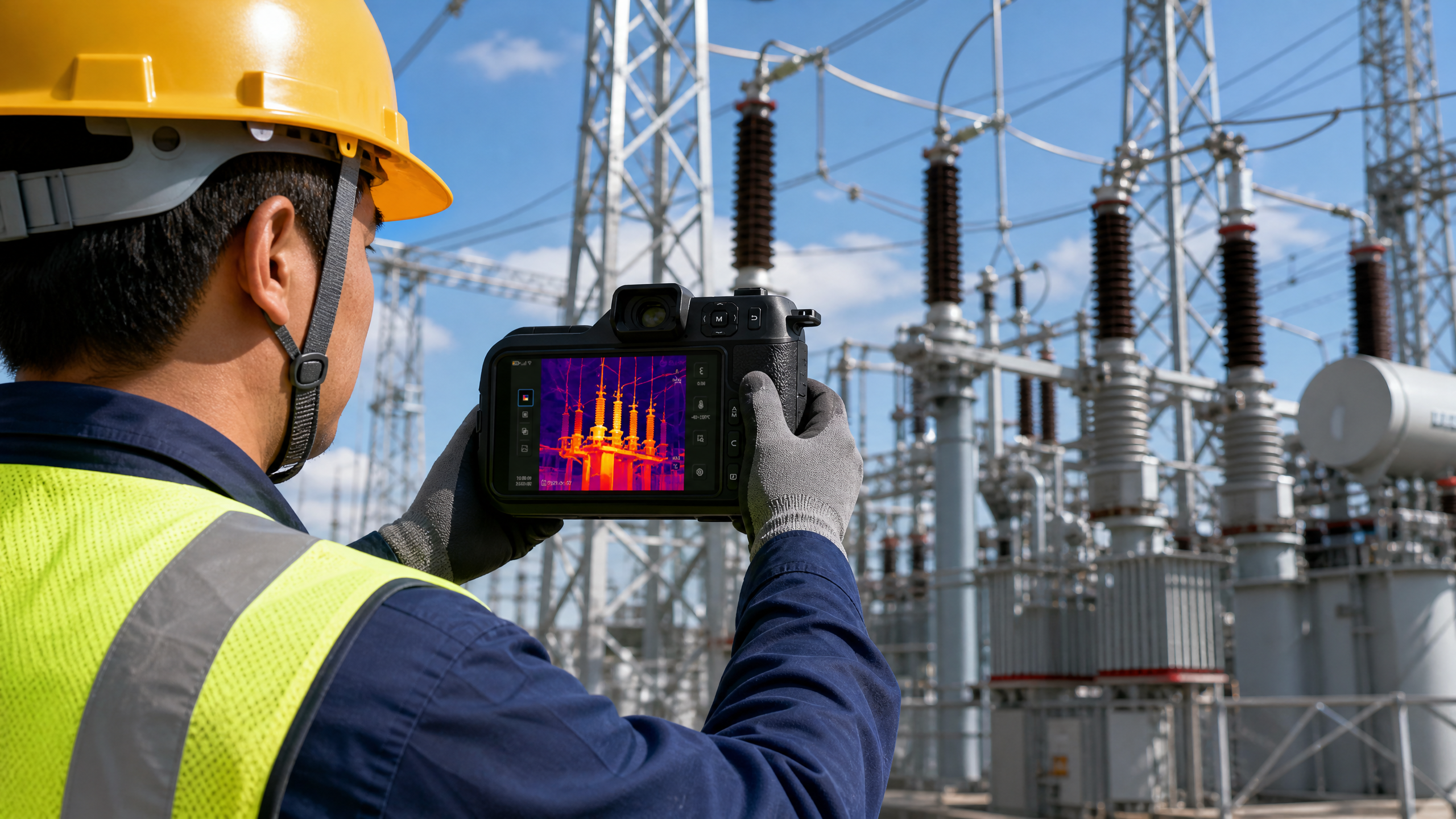
Choosing between the SW136 vs SW234 acoustic camera looks like a simple specification question — 136 microphones against 234, 130 m against 200 m — and it is almost always decided the wrong way. Buyers compare the two headline numbers, pick the larger pair, and then discover the extra range is unusable in the noisy outdoor yard they bought it for, or that a 900 g instrument is too heavy to hold overhead for the panel work that makes up most of their inspection calendar.
Both instruments are real, both are in production, and both share the same core architecture: a MEMS microphone array feeding a 2 kHz–100 kHz acoustic processing chain that overlays a sound map on an 800×480 image, shown on a 5-inch sunlight-readable display, in an IP54 housing, with built-in GPS and photo/video capture. What separates them is channel count, quoted detection distance, wireless transmission and 100 g of mass. Everything else in this comparison is about matching those four differences to the work you actually do.
The models discussed here are the ones we supply and support: the SW136, the SW234, and — where a temperature reading is also required — the all-in-one GSW Series. Where a datasheet value is not published for a model, this article says so rather than inferring it.
The Short Answer
If at least three-quarters of your inspections happen inside a substation fence, a compressor room, a production hall or a switchgear corridor — that is, at working distances under roughly 30 m — the SW136 covers the requirement, weighs 800 g, and leaves budget for the instrument that acoustic cameras cannot replace: a partial discharge detector that quantifies what the array only localises.
If your calendar is dominated by outdoor switchyards, transmission structures, high racks, tank farms or remote sites where a technician works alone and reports to an engineer hundreds of kilometres away, the SW234's 200 m quoted range, its Wi-Fi/4G transmission and its higher channel count are worth the extra 100 g and the higher price.
And if you expect to take a temperature reading on the same walk — a hot lug beside a hissing insulator, a bearing running warm next to a leaking steam trap — neither acoustic camera can do it. That requirement points at the GSW Series, which pairs a 640×512 thermal channel with a 136-microphone array and a 40 m laser rangefinder.
The right question is not “how many microphones?” but “at what distance, in what background noise, do I need to separate one weak source from everything else?” Channel count and range are answers to that question, not substitutes for it.
What the Extra 98 Microphones Actually Buy
An acoustic camera is a beamformer. Every microphone samples the same sound field at a slightly different time, and the processor delays and sums those samples so that one direction adds constructively while the rest cancels. Two properties matter, and they are set by different things.
Angular resolution is set by aperture, not by channel count. The physical size of the array and the wavelength you are listening to decide how small an angle the instrument can resolve. At 40 kHz the wavelength in air is about 8.6 mm; a smaller spacing between elements aliases at high frequency and produces grating lobes — ghost sources that appear where nothing is leaking. Both models in this comparison operate to 100 kHz, which is why their arrays are dense and why a buyer should treat any claim of high-frequency performance without a stated array geometry with suspicion.
Channel count buys array gain and contrast. For uncorrelated background noise, array gain rises with the number of elements: going from 136 to 234 channels is a theoretical improvement of about 2.4 dB (10 × log10(234/136)). Two and a half decibels sounds trivial until you are standing in a switchyard where corona from a nearby insulator string, cooling fans and wind are all louder than the partial discharge you are trying to find. Array gain is what pushes the wanted source above that floor, and more elements also suppress the sidelobes that smear a strong source across the map and hide a weak one next to it.
In practical terms: at 3 m from an open panel, both instruments will put you within centimetres of a leaking gasket, because the source is loud and the geometry is easy. At 60 m across a yard, with a 400 kV string in the frame, the difference in channel count is the difference between a map you can act on and a map you have to interpret.
Sound level falls fast — and that governs everything
Distance is not a linear penalty. Sound pressure from a small source falls with the inverse square law, which is 6 dB per doubling of distance. The table below converts that into the loss relative to one metre, and it explains why 130 m and 200 m are closer in practice than the numbers suggest.
| Distance | Level loss vs 1 m | What it means for an acoustic survey |
|---|---|---|
| 5 m | −14 dB | Panel and compressor-room work; any array in this family is comfortable |
| 20 m | −26 dB | Indoor switchgear hall, ceiling pipework, motor room |
| 40 m | −32 dB | Small outdoor yard; background noise starts to dominate |
| 80 m | −38 dB | Yard walkdown; source must be energetic to stand out |
| 130 m | −42 dB | SW136 quoted limit |
| 200 m | −46 dB | SW234 quoted limit — 3.7 dB beyond the 130 m point |
The step from 130 m to 200 m is 3.7 dB. That is roughly the same order of magnitude as the array gain from the extra channels, which is why the two differences belong to the same purchasing argument: the SW234 is not simply “longer”, it is a more sensitive instrument at the distances where you need sensitivity, and the range figure is the visible consequence.
130 m vs 200 m: Reading a Detection Range Honestly
Every acoustic camera datasheet quotes a detection distance, and every one of those numbers is conditional. A range is only meaningful with the reference leak, its pressure or flow, the background noise level and the frequency band stated — a 0.5 mm orifice at 5 bar in a quiet field is a very different target from a 0.2 mm gasket leak inside a running plant. When you request a quotation from us, ask for the test conditions behind the range figure. We would rather send you the conditions than have you buy a range you cannot reproduce.
Three practical rules follow from this.
First, range buys triage, not precision. At 130 m the acoustic beam covers a patch of structure several metres across. You will know which phase, which bay, which insulator string — you will not know which bolt. Beyond about 50 m, the value of an acoustic camera is that it tells you where to send the bucket truck, the clamp meter or the ultrasonic probe. That is a genuine saving in an outage or a night shift, and it is how our outdoor substation case study documents the workflow.
Second, the environment usually sets the real limit. In a quiet rural yard, 150 m is achievable. Beside a compressor house with the doors open, 20 m may be the honest limit for a small leak, and no microphone count will change that. Match the instrument to the noise floor you will actually be standing in, not the one in the brochure.
Third, wind and rain cost you range before they cost you accuracy. IP54 covers dust and splashing water, and both models carry it, but turbulent air refracts ultrasound and scatters it. A 20 km/h crosswind on an exposed yard is worth several metres of lost detection distance on any array. Plan outdoor surveys for low-wind hours and treat the difference between a calm and a windy day as the difference between two instruments.
Side-by-Side Specification Table
The table below uses published datasheet values only. Where a value is not published for a model, it is marked as such rather than estimated from the sibling product.
| Specification | SW136 | SW234 | GSW Series (reference) |
|---|---|---|---|
| Microphone array | 136 digital silicon MIC | 234 digital silicon MIC | 136 digital silicon MIC |
| Frequency bandwidth | 2 kHz – 100 kHz | 2 kHz – 100 kHz | 2 kHz – 100 kHz |
| Detection distance | 0.3 – 130 m | 0.3 – 200 m | 0.3 – 130 m |
| Acoustic / visible image | 800 × 480 | 800 × 480 | 800 × 480 acoustic; 640 × 512 IR |
| Thermal channel | None | None | 640 × 512, 8–14 µm, ±2 °C or 2 % |
| Display | 5-inch sunlight-readable, 800×480 | 5-inch, 800×480 | 5-inch |
| MIC sensitivity | −26 dBFS @ 1 kHz | Not published | Not published |
| Visible-light FOV | 66° | Not published | Not published |
| Wireless transmission | Not published | Wi-Fi and 4G | Not published |
| GPS | Built-in | Built-in | Not published |
| Laser rangefinder | None | None | 40 m, ±1 cm or 1‰ |
| Storage | 32 GB SD card | SD card (capacity confirmed per quotation) | Not published |
| Battery life | > 2 hours | Not published | Not published |
| Operating temperature | Not published | −20 °C to +55 °C | −20 °C to +150 °C / 0 °C to +410 °C (measurement range) |
| Weight | 800 g | 900 g | Not published |
| Dimensions | Not published | 133 × 147 × 271 mm | Not published |
| Protection | IP54 | IP54 | IP54-class housing; confirm per quotation |
| Photo / video capture | Yes | Yes | Yes |
Three rows deserve comment because buyers over-weight them. The bandwidth is identical — both cover the 2–100 kHz band that contains compressed-air ultrasound, steam and vacuum leaks, and the acoustic emission from surface partial discharge. The acoustic image resolution is identical, so a screenshot from either instrument carries the same pixel density; what differs is how cleanly the source appears inside it. And both are IP54, so neither is the “outdoor” model on ingress protection grounds alone. The outdoor case for the SW234 rests on range, channels and connectivity.
When the SW136 Is the Better Purchase
The SW136 is the instrument to specify when the survey programme is dense, repetitive and close-range. That describes most industrial inspection calendars: monthly panel scans, quarterly compressed-air audits, annual PD screening of a few hundred MV cubicles, steam-trap rounds, and leak surveys on vacuum lines where the working distance is set by the aisle rather than the horizon.
At 800 g it is 100 g lighter, which matters more than it reads. An acoustic camera is held at arm's length and often above head height; a 100 g penalty compounds over a two-hour walkdown and shows up as shortened dwell time at each asset — which is exactly where faults get missed. Teams that inspect overhead busbar, ceiling pipework or racking all day notice the difference within a week.
Its 130 m quoted range covers indoor switchgear halls, compressor rooms, production lines and the near half of most distribution yards. If your utility's inspection standard already requires a walkdown within a few metres of each asset — and most do, because you need the visual check anyway — the extra 70 m is buying capability the procedure will never use.
There is also a portfolio argument. An acoustic camera localises a source; it does not measure it. If the budget covers one instrument, the combination of an SW136 plus an HPD500 partial discharge detector — five detection methods, including HFCT sensitivity of ≤ 3 pC — will answer more questions about a switchgear fleet than a single SW234 will. That pairing is the one we most often quote to utilities building a first predictive-maintenance toolkit, and it is documented in our combined inspection workflow.
When the SW234 Pays for Itself
The SW234 earns its premium in four situations, and they tend to arrive together.
Outdoor yards and transmission work. A 200 m quoted range lets a technician screen a line bay, a gantry or a string of surge arresters from a safe distance, at ground level, without an outage or a climb. Where the alternative is a bucket truck and a switching order, the instrument pays for itself in avoided access costs rather than in inspection quality. Our corona detection guide sets out what that screening can and cannot conclude.
High channel count in a noisy environment. The 234-element array's advantage is contrast, and contrast is what a switchyard takes away. If your sites have multiple simultaneous sources — several bays energised, cooling plant running, adjacent road traffic — the extra channels are doing real work at 40–80 m, which is precisely the band where the SW136 becomes dependent on operator skill.
Remote sites and lone working. Wi-Fi and 4G transmission changes the reporting model. A technician can stream the acoustic map to a tablet or to an engineer at head office and get a second opinion before leaving site, and the evidence lands in the asset record with GPS coordinates attached, rather than in a folder that gets transcribed three days later. For a utility whose specialists are centralised and whose sites are not, this is often the deciding feature.
Large-area surveys at pace. Long-range detection triages faster. One operator can cover a yard in an hour that would take half a day bay by bay, then spend the saved time confirming the two or three sources that mattered.
What the SW234 does not fix is close-range precision or weight. If your work is 90 % panels and compressor rooms, its advantages are dormant and you are carrying 100 g and a higher price for a capability the procedure never invokes.
The Gap Neither Model Closes
Both instruments answer “where is the sound coming from?” Neither answers “how bad is it?” or “how hot is it?”. Being clear about that boundary is what keeps a capital request from being rejected on the second review.
Neither measures partial discharge. An acoustic camera detects and localises the sound of discharge, which is exactly what you want for finding a source in a yard. It does not give you apparent charge in pC, dBµV or a PRPD pattern you can trend against IEC 60270-style limits. If the deliverable is a condition assessment with severity classes, you need a detector: the HPD200 for TEV and airborne acoustic screening, or the HPD500 when cable and GIS work demand UHF and HFCT. The division of labour — array to find, detector to grade — is the same conclusion our TEV versus acoustic comparison reaches from the other direction.
Neither measures temperature. For a hot joint at the same terminal as a hissing insulator, the acoustic map is silent about the heat. Two routes exist: carry a handheld thermal camera such as the EasIR Series alongside, or specify the GSW Series, which puts a 640×512 thermal channel and a 136-microphone array in one body with real-time fusion and a 40 m laser rangefinder. For teams that must document both phenomena in a single pass, the all-in-one usually wins on time even though a dedicated thermal camera reaches higher temperatures.
If you are comparing an all-in-one against a two-instrument kit, the trade-offs are set out in our GSW versus FA611S comparison and, for the detection-method question, in thermal versus acoustic PD detection.
Quotation Checklist: Twelve Questions
Send these answers with your enquiry and model selection stops being a guess. We quote against them, and we will tell you when the answer is “neither model”.
- Assets and phenomena. Compressed air, steam, vacuum, natural gas, SF6, or partial discharge — and which of these dominates.
- Typical working distance. The distance from where the operator can legally stand to the asset, not the distance you would like to reach.
- Maximum distance. The single furthest target that must be screened from the ground, and whether that target can instead be reached during a planned outage.
- Background noise. Simultaneous sources in the same field of view: energised bays, fans, compressors, traffic, wind exposure.
- Indoor or outdoor. Sunlight readability, rain exposure and operating temperature range all follow from this.
- Reporting requirement. Whether images must carry GPS coordinates, be transmitted off-site the same day, or be exported into an asset-management system.
- Thermal requirement. Whether a temperature reading must be taken on the same walk — the deciding question between one instrument and two.
- Quantification requirement. Whether severity grading in pC or dBµV is part of the deliverable.
- Operators and training. How many people will use it, and whether a lighter instrument improves dwell time on the walkdown.
- Accessories. Spare batteries, SD cards, carry case, tripod mount, replacement microphone protection.
- Documentation. Calibration or test reports, and the certification documents required for import in your country. These are confirmed per model and per quotation — we do not claim a blanket certification across the range.
- Quantity, delivery country and timeline. Including whether neutral or OEM branding is required.
Two answers usually settle the model before we reach question seven: the maximum ground-level screening distance, and whether a temperature reading is in scope. Everything else refines the quotation.
Verdict
The SW136 is the correct purchase for dense, close-range programmes — substations, compressor rooms, production halls, MV switchgear fleets — where 130 m of quoted range exceeds anything the procedure will use, and where the money is better spent pairing the array with a partial discharge detector that can grade what the array finds. The SW234 is the correct purchase when the survey physically runs long: outdoor yards, transmission hardware, remote sites, and any programme where Wi-Fi or 4G reporting removes a transcription step. The 234-element array is not marketing ballast — it buys contrast in exactly the environment where contrast is scarce.
Neither is a thermal camera and neither quantifies discharge. Decide those two questions first, then choose the array. If you send us the twelve answers above, we will confirm the model, the accessories and the documentation for your country, and say so if a different instrument serves you better.
Buy the array for the distance you must screen from the ground, and buy the detector for the number you must write in the report. Utilities that reverse that order end up owning two instruments and using one.
Which array fits your survey?
Send the phenomena you inspect, the maximum ground-level screening distance, the background-noise conditions, whether a temperature reading is required, and the delivery country. We will confirm the model and configuration — SW136, SW234 or the all-in-one GSW — and quote it with the documents your import process needs.